Full U.S. Tract Explorer
Browse nationwide with Need Pressure, Gospel Shift, and Gospel Desert overlays before you make placement or investment decisions.
Most churches make neighborhood decisions — where to plant, where to invest, where to stay — without anything to watch. GospelGraph is the instrument panel, built around two hard claims: Gospel impact in a geographic area can be measured over time, and that movement can be explained in language a pastor can actually use.
The breakthrough
That is the real product claim. Not generic church analytics. Not another neighborhood profile. GospelGraph tracks directional movement at the tract level so ministry leaders can see whether a place is hardening, softening, compounding, or stalling.
And it does not stop at raw scores. The system explains what the movement means in pastoral terms — the kind of language a planter, session, or elder team can actually act on without needing to think like data analysts.
The result is not omniscience. It is disciplined visibility: a way to compare places, watch change across years, and make field decisions with something stronger than anecdote.
The GospelGraph Explorer
The Explorer is the operating surface for that breakthrough. It lets you inspect tract conditions, directional change, and field pressure over time — then translate the signal into pastoral interpretation, compare places, and run unlimited field reports inside the full platform.
Get access to the explorer →Gospel Shift (5yr)
Census Tract 7027.02
Gospel Shift (5yr) · open field report
What the explorer gives you
Not a dashboard for dashboard people. A field instrument for pastors, planters, and ministry leaders who need neighborhood clarity before they move bodies, dollars, and years.
Browse nationwide with Need Pressure, Gospel Shift, and Gospel Desert overlays before you make placement or investment decisions.
Inspect the five-domain Gospel Impact composite for any selected tract instead of settling for a single flattened score.
Type any U.S. address and jump straight to the tract it lives in, with the surrounding ministry context already in frame.
Compare current tract conditions to the 2020 baseline and distinguish momentum from rising neighborhood pressure.
Bring pastoral interpretation, domain trend arrows, and elder-ready outputs into the room before strategic decisions get made.
Plant, reallocate, or double down with neighborhood clarity instead of relying on anecdote, intuition, or post hoc explanation.
Live preview · U.S. map
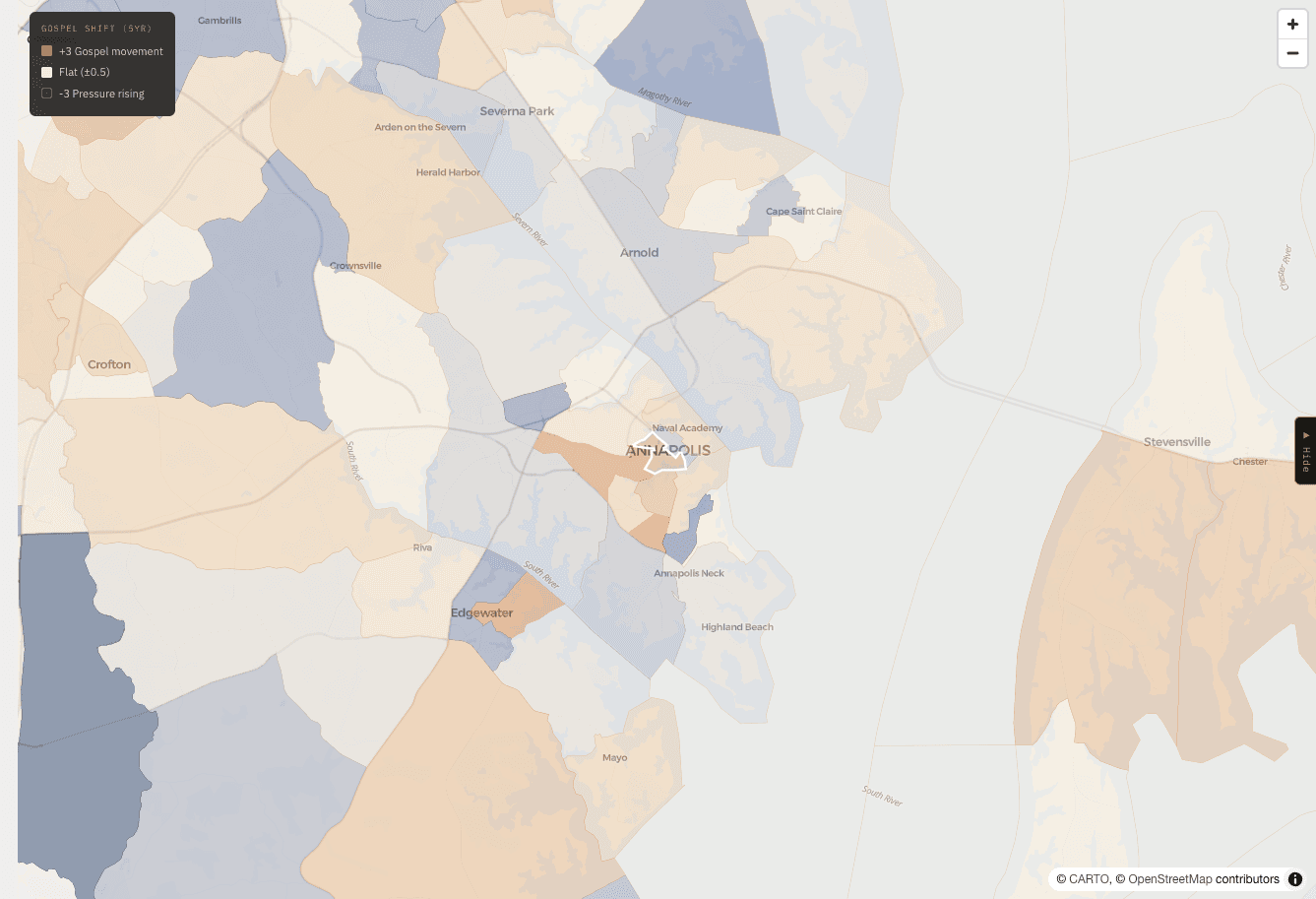
Use the live map to search an address, inspect the tract, and preview neighborhood movement before you open a free field report for that place or step into the full Explorer workflow.
-3 or less
-1.5
Flat
+1.5
+3 or more
Change vs 2020 composite (amber = Gospel movement, navy = pressure rising; scaled ±10 pts).
Zoom anywhere in the U.S. and tap a tract.
Amber signals momentum gaining. Navy signals pressure rising.
These calculations show pressure or lift in the tract-level blend of safety, housing, health, and reconciliation conditions that tend to shift when the Gospel takes root. Correlation to ministry impact still requires local church diagnostics (see the Field Diagnostic package).
Select a tract to see its Gospel Impact breakdown.
Run a free field report for a specific address. Explorer subscribers get unlimited field reports, full domain breakdowns, trend data, and pastor-readable interpretation for every tract in the platform.
One address. One tract. The wound, the people, the call — in five sections.
Start with one address · Free field report
Start with a free field report on a particular address. When you need unlimited field reports, tract comparison, and full nationwide ministry intelligence, move into the Explorer.
Free report first. Full Explorer access when you need unlimited reports and platform-wide visibility.
I did not build this tool because I saw a market gap. I built it after three years of incarnational mercy ministry in public housing.
Why trust this
GospelGraph sits at the convergence of engineering, journalism, and theology. It was built by someone who has written production software, reported for a living, and spent years learning to read neighborhoods without romanticism.
This is not abstract analytics theater. It is pastoral production software — built to help planters, pastors, and ministry leaders see the ground with enough clarity to act before momentum is lost or pressure is misread.
I did not hire someone to build this. I built it. That matters more than the methodology.
Read the methodology →In practice
A Baltimore church planter knew something was moving in the neighborhood — relationships forming, households opening, small signs of fruit. What he did not have was a way to show his elders what he could already feel.
He opened the field report. Reconciliation was climbing. Social capital was compounding. He walked into the meeting with domain scores, trend arrows, and pastoral interpretation already attached.
2 Corinthians 4:7 · Jars of clay
Use GospelGraph to see more clearly. Let it push you toward the street, not away from it. Never let the score replace the face of the neighbor you’re called to love.